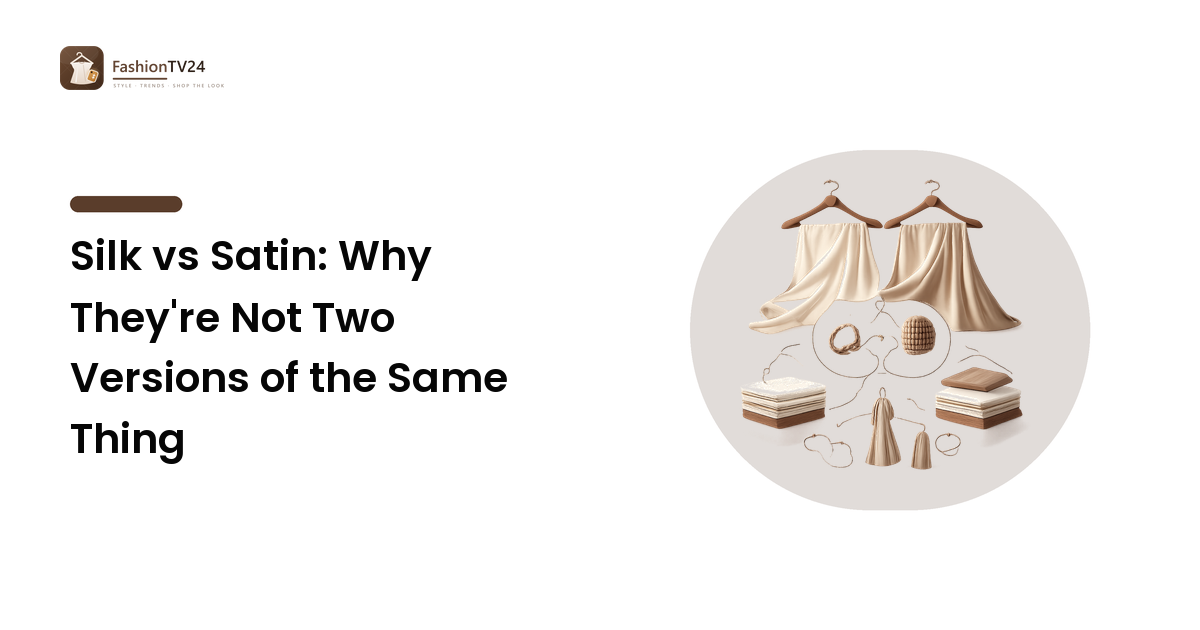
Silk is a fiber — the filament spun by silkworms. Satin is a weave — a way of interlacing yarns so that most of the thread floats on the surface, which is exactly what produces that liquid shine. They are not competing materials. A fabric can be satin made of silk, satin made of polyester, or silk woven in a completely matte structure. When a label says "satin," it is telling you how the cloth was built, not what it is made of.
That single distinction resolves most of the confusion in the fitting room, and it also explains the price gap that looks inexplicable on the rack: two garments with the same glossy face can be separated by the fiber underneath, and the fiber is what decides how the piece breathes, drapes, ages, and washes.
What does "satin" actually tell you on a label?
A satin weave floats each warp yarn over several weft yarns before tucking it under one. Few interlacings means an unusually smooth face with very little texture to break up light — hence the shine — and a duller, flatter back. That structure is the same whether the yarn is silkworm filament, polyester, nylon, acetate, or a blend.
Some names worth knowing, because shops use them interchangeably and they don't mean the same thing:
- Silk satin — satin weave in silk. Often labeled charmeuse when it's the lightweight, fluid version with a matte reverse.
- Polyester satin — satin weave in polyester, and what most garments simply labeled "satin" are made of.
- Sateen — the same float structure worked in spun cotton. Softer, with a subtler sheen than a filament satin, and the usual finish on smooth cotton bedding.
- "Silky," "silk-touch," "satin finish" — marketing words describing an effect, with no fiber claim attached at all.
The composition label sewn into the seam is the one that has to be accurate. The swing tag on the front is where the adjectives live. If the two disagree, believe the seam. Reading those labels properly is a skill in itself, and our guide to fiber labels covers what the percentages tell you.
How can you tell silk from polyester satin in a shop?
Read the label first — it settles it. When there's no label, or you want to check a secondhand find, four quick tests get you a long way:
- Warmth. Silk takes on the warmth of your hand within seconds and holds it. Polyester feels cool at first touch and then turns slightly clammy, because it isn't moving any moisture away from your skin.
- The quality of the shine. Silk has a deep luster that shifts color subtly as you turn it, because its filament is triangular in cross-section and scatters light unevenly. Polyester tends toward a brighter, more uniform, almost mirrored gloss.
- Crush and release. Gather a corner in your fist, hold for a few seconds, and open your hand. Silk creases softly and relaxes as you watch. Polyester either springs back with no memory at all or holds sharp, glassy wrinkles.
- Drape over the hand. Silk satin falls in narrow, fluid folds and follows the shape underneath. Polyester at a similar weight forms wider, stiffer folds that stand slightly away.
The classic burn test — silk smells of burnt hair and turns to ash; polyester melts into a hard bead — is genuine, but only ever done on a loose thread from a seam allowance of something you already own. It has no place in a shop.
Which one suits what you're buying?
Neither wins in the abstract. What matters is what the garment has to do.
| Silk satin | Polyester satin | |
|---|---|---|
| Drape | Fluid, narrow folds, moves with you | Fuller, more structured, holds a shape |
| Next to skin | Breathes, buffers temperature | Traps heat and moisture |
| Marking | Water spots; vulnerable to perfume and deodorant | Shrugs off water; can hold odor |
| Color | Deep, changeable, slightly uneven | Intense, flat, very consistent |
| Snagging | Snags easily | Snags easily — it's the weave, not the fiber |
| Care | Hand wash cool or dry clean; cool iron | Machine wash cool; low heat only |
| Cost driver | The fiber itself | Finishing and print quality |
An occasion dress or a bias-cut skirt is where silk earns its price. Fluidity is the whole effect, and polyester at the same weight moves differently in a way that reads on camera and in motion.
A blouse worn through a working day is a real trade-off. Silk regulates temperature and stays comfortable in a warm room; it is also the fabric most likely to show a water mark or take permanent damage from perfume sprayed after dressing. Polyester survives daily handling but holds body odor, and once it does, it holds it through washing.
A lining is usually the sane place to save. Polyester satin lining is durable, cheap, and slides well. Silk lining is a genuine luxury worth having only in a coat or jacket you expect to keep for many years.
A scarf, a tie, or anything knotted favors silk: it takes dye more deeply, ties without bulk, and holds a knot without slipping loose.
A pillowcase is the case people get wrong. The reduced friction that makes satin pillowcases popular for hair and skin comes from the smooth woven surface, not from the fiber — so a polyester satin pillowcase delivers most of that effect for a fraction of the price. What silk adds is temperature and moisture management: it stays cooler and less clammy through the night. Choose on that, and on how much washing care you want to take on.
What does each one cost you in care?
This is where the difference bites hardest, long after the purchase.
Silk is a protein fiber, chemically closer to hair than to cotton, and it dislikes four things: heat, chlorine bleach, enzymes, and prolonged sunlight. Follow the care label; where hand washing is permitted, use cool water and a detergent made for delicates — biological detergents are formulated to break down protein, and silk is protein. Never wring it. Dry flat away from direct sun, which weakens and yellows the fiber over time. Iron cool, on the reverse, while slightly damp. Deodorant and perfume should go on and dry before the garment does.
Polyester satin washes easily but melts. A hot iron will permanently glaze the surface into a shiny patch that cannot be reversed, so keep the iron low and use a pressing cloth. Wash cool to limit pilling at the friction points, and remember that polyester holds oils, which is why odor persists in it more than in natural fibers.
Both share one weakness: those long surface floats catch on everything. Rings, watch clasps, rough nails, velcro, and unfinished furniture edges all pull threads, and a pulled float on satin is far more visible than a snag in a textured weave. Handle it accordingly — the general principles are in our guide to making clothes last, and the construction cues that separate a good satin garment from a poor one are in our checklist for spotting well-made clothes.
When does the choice genuinely not matter?
More often than the price difference suggests:
- A lining nobody will see or feel. Buy the durable one.
- A piece for one occasion. If it's worn once and photographed, polyester's flat, saturated color often shoots better than silk's shifting luster.
- A structured garment where the silhouette is built by cutting, boning, or interfacing. The fabric isn't doing the draping, so the fiber matters less.
- Cold weather, short wear. Breathability barely registers on a two-hour evening out in a cool room.
Where it always matters: anything worn against the skin all day in the heat, anything you intend to keep for years, and anything whose entire appeal is the way it moves.
FAQ
Is satin always shiny on both sides?
No — one-sided shine is the signature of a true satin weave. A shiny face with a matte reverse tells you the structure is genuine rather than a coating or finish applied to the surface.
Is sateen the same as satin?
Same float principle, different yarn. Sateen is usually spun cotton, so it reads softer and less glassy, and it breathes better than a filament satin. It's the standard finish on smooth cotton sheets.
Is charmeuse silk?
Charmeuse names a lightweight satin weave with a matte back. It's most often silk, but the same construction is made in polyester, so the word alone is not a fiber guarantee — check the composition.
Does "silky" or "satin finish" mean there's silk in it?
No. Those describe a feel or an effect and carry no fiber content. Only the composition label makes a claim about what the fabric actually is.
Is polyester satin bad for hair?
It's much smoother than a standard cotton weave, so it creates less friction than the pillowcase most people are replacing. Where silk pulls ahead is breathability and moisture, not slipperiness.
Can I wash silk satin at home?
Sometimes — the care label decides, and dark or heavily dyed pieces can bleed. Where hand washing is allowed, cool water, a delicates detergent, no wringing, and drying flat in the shade will do it.
Once you know that one word describes the fiber and the other describes the weave, the shelf stops being confusing: check the composition label, then choose the fiber by the job the garment has to do. For more on choosing fabrics, spotting quality, and building a wardrobe that lasts, visit FashionTV24.